Text messaging has an unusual position in marketing: almost everyone reads their texts, and almost every business handles them badly. The channel that gets the most attention per message sent is also the one where a single careless campaign can burn a list permanently.
Here’s how mass text messaging actually works, what it’s good for, and how to run it without wrecking your list or your compliance position.
What mass text messaging is
Mass text messaging — sometimes called bulk SMS or text blasting — is sending one message to a large group of contacts at once, usually with personalization so each recipient sees their own name and details. It’s the same idea as an email blast, delivered to a channel people actually check.
The mechanics are simple. The interesting part is the constraints, because SMS is a fundamentally different medium from email and the habits don’t transfer.
Why it works
People read texts. Not eventually — within minutes. There’s no promotions tab, no filtering, and no unread pile a thousand messages deep.
Replying is effortless. One tap and a few words. Compared with composing an email or returning a call, the friction is close to zero, which is why response rates are so much higher.
It’s short by design. A 160-character limit forces clarity. There’s no room for a paragraph of preamble, which tends to make SMS copy better than most email copy by default.
Where it fails
It’s easy to overuse. Because texting feels personal, over-messaging feels like an intrusion in a way that an extra email doesn’t. Send too often and people don’t just ignore you — they opt out.
Compliance is strict and actively enforced. SMS marketing carries real legal obligations around consent and opt-out handling, and it’s one of the more litigated areas of outbound marketing.
There’s no room for nuance. If your message needs explanation, context, or tone, SMS is the wrong tool. That’s what a voicemail drop is for.
What to use it for
The best SMS campaigns share a trait: the recipient can act on them in a few seconds.
- Appointment reminders and confirmations — the highest-value, lowest-risk use there is
- Time-sensitive offers with a real deadline
- Follow-ups after a voicemail drop, giving people a lower-friction way to respond
- Delivery, status, and account notifications
- Links to a form, a booking page, or a document
- Simple re-engagement — one question to a list that’s gone quiet
What to avoid: long explanations, multi-step asks, and anything the recipient would need to sit down and think about.
Writing a text that gets replies
Say who you are immediately. An unknown number with no identification reads as spam and gets reported.
One idea, one ask. If your message has two requests, it has none.
Make the action obvious. “Reply YES to confirm” outperforms “let us know if that works.”
Include opt-out instructions. Both a legal requirement in most cases and a trust signal.
Keep it under 160 characters where you can. Longer messages split, which costs more and reads worse.
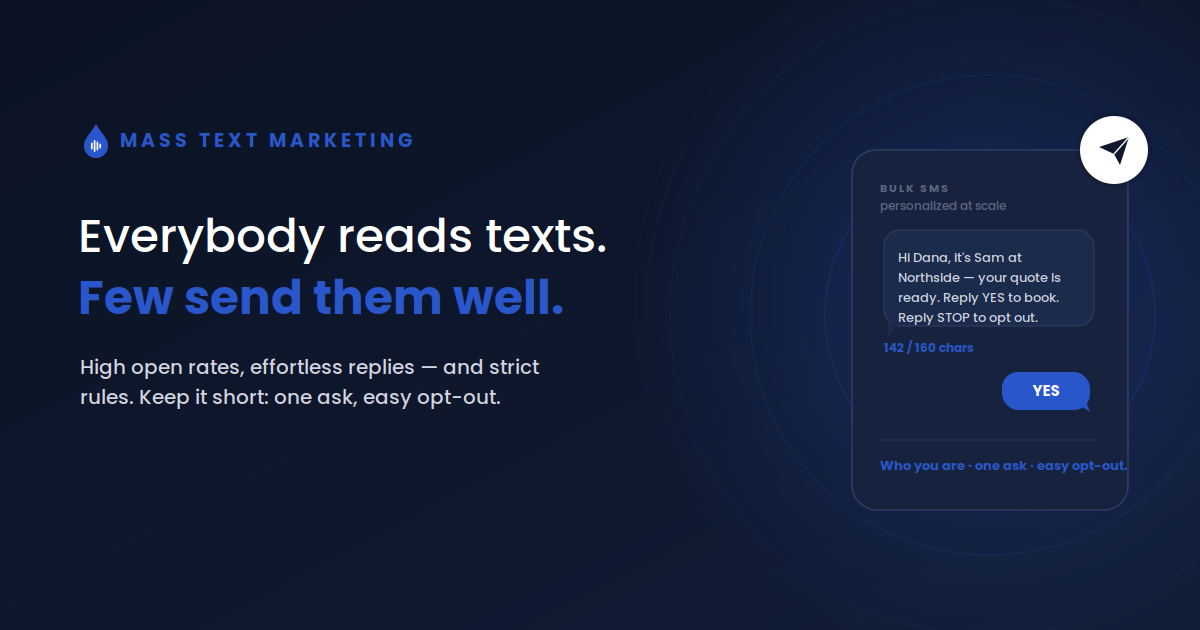
A workable template: “Hi [Name], it’s [Your Name] at [Company] — [one-sentence reason]. [Clear action]. Reply STOP to opt out.”
Consent and compliance
The core rule is the same as any outbound channel: you need permission, and you need to be able to prove it.
Practically, that means collecting consent with clear language about what people are signing up for, storing the record of when and how they agreed, processing opt-outs immediately and permanently, and identifying yourself in every message. Requirements vary by jurisdiction and change over time, so treat this as a moving target and get advice specific to your program.
This is general information, not legal advice.
How often to send
Less than you want to. For most lists, a couple of marketing messages a month is a reasonable ceiling, with transactional messages — confirmations, reminders, status updates — sitting outside that count because recipients expect them.
The signal to watch is your opt-out rate. If it climbs after a send, you either messaged too often or messaged the wrong people.
Pairing SMS with voicemail
The two channels cover each other’s gaps almost exactly. A voicemail drop does the persuasive work — it has room for tone, context, and a real reason to engage. A text a day or two later catches everyone who listened but didn’t act, and hands them an easier way to respond.
Voice first for the message, text second for the conversion. That sequence outperforms either channel run alone.