
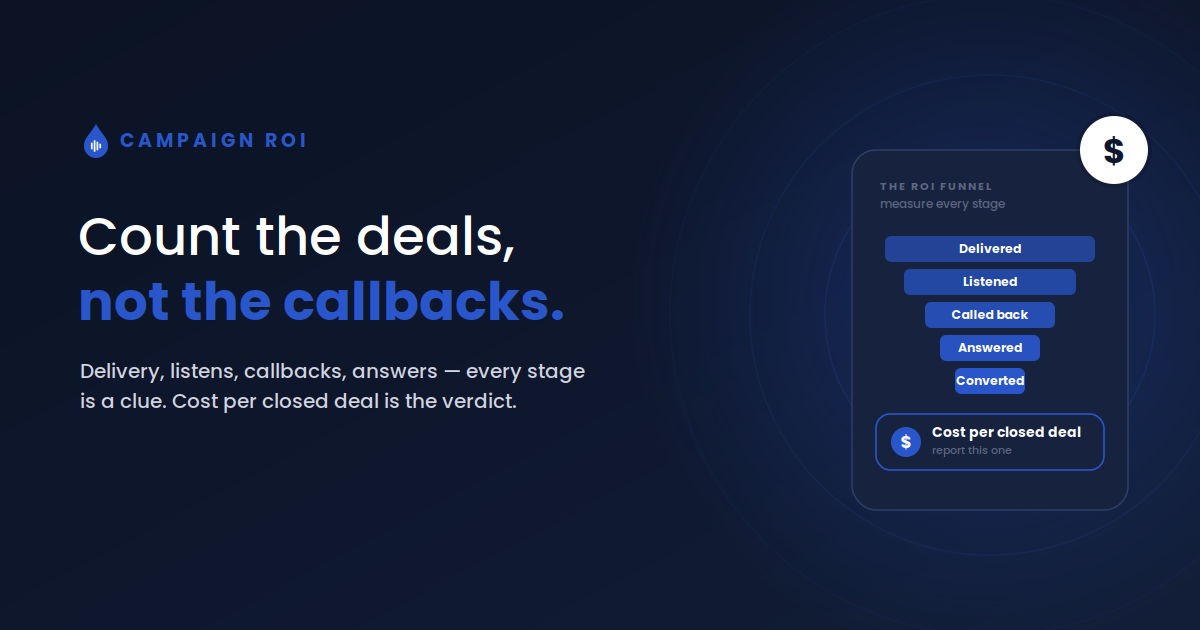
Most teams measure voicemail campaigns by the number that’s easiest to see: how many drops went out, and how many people called back. Both are worth knowing. Neither tells you whether the campaign made money.
Here’s the set of numbers that actually does.
Start with cost per contact, not cost per drop
Your per-drop rate is the cheapest input in the whole equation, and focusing on it hides the real cost.
The number that matters is cost per conversation — total campaign spend divided by the number of actual conversations it produced. That includes the drops, the agent time spent handling callbacks, and anything you spent acquiring the list.
A campaign at a fraction of a cent per drop that produces no callbacks is infinitely expensive. A campaign at five cents a drop that fills a calendar is cheap.
The metrics worth tracking
Work down the funnel in order. Each stage tells you where a problem lives.
Delivery rate. What share of your list actually received the message. Low delivery points at list quality — bad numbers, stale data, formatting problems.
Listen rate. How many recipients played the message. If delivery is strong but listens are weak, the issue is upstream of your script.
Callback rate. Percentage of recipients who called back. This is where your script and offer get judged.
Answer rate on callbacks. The one nearly everyone forgets. If a third of your callbacks reach voicemail because nobody was available, you paid for those contacts and threw them away.
Conversion rate. Callbacks that became appointments, applications, or sales.
Cost per acquisition. Total spend divided by closed deals. The only number that settles the argument.
Diagnosing a weak campaign
The value of tracking each stage is that it tells you what to fix instead of guessing.
Delivery low? Clean the list. Validate numbers, deduplicate, and check your source.
Delivery fine, listens low? Usually timing or audience relevance rather than the recording itself.
Listens fine, callbacks low? It’s the script. The message got heard and didn’t give anyone a reason to act.
Callbacks fine, answers low? An operational problem, not a marketing one. Pace your sends with trickle delivery and put IVR in front of the queue so nobody hits a dead end.
Everything fine, conversions low? The message is attracting the wrong people, or the handoff to your agents is losing them.
Each of those has a different fix, and without stage-level data you’d be rewriting your script when the actual problem was staffing.
Attribution: connecting a drop to revenue
This is where most measurement falls apart, because a callback arrives as an ordinary inbound call with no obvious link to the campaign that caused it.
A few practical approaches:
Use a dedicated callback number per campaign. The cleanest method — any call to that number is attributable by definition.
Ask. Have agents log which campaign the caller is responding to. Imperfect but cheap.
Match against the sent list. Compare inbound numbers to the numbers you dropped to. Reliable when your CRM can do the lookup automatically.
Watch the time window. Callbacks cluster in the hours after a send, so a lift in inbound volume immediately following a campaign is meaningful even without perfect matching.
Comparing campaigns properly
Two rules make comparisons trustworthy.
Change one thing at a time. If you alter the script, the send time, and the list all at once, you learn nothing about which one moved the number.
Give it enough volume. Callback rates on a hundred-contact test swing wildly by chance. Run enough drops that the difference means something before you draw conclusions.
The number to report
If you only track one figure, track cost per closed deal, by campaign.
Everything else is diagnostic. That one number tells you whether to run the campaign again, and it lets you compare voicemail honestly against every other channel competing for the same budget — which is, in the end, the decision you’re actually trying to make.