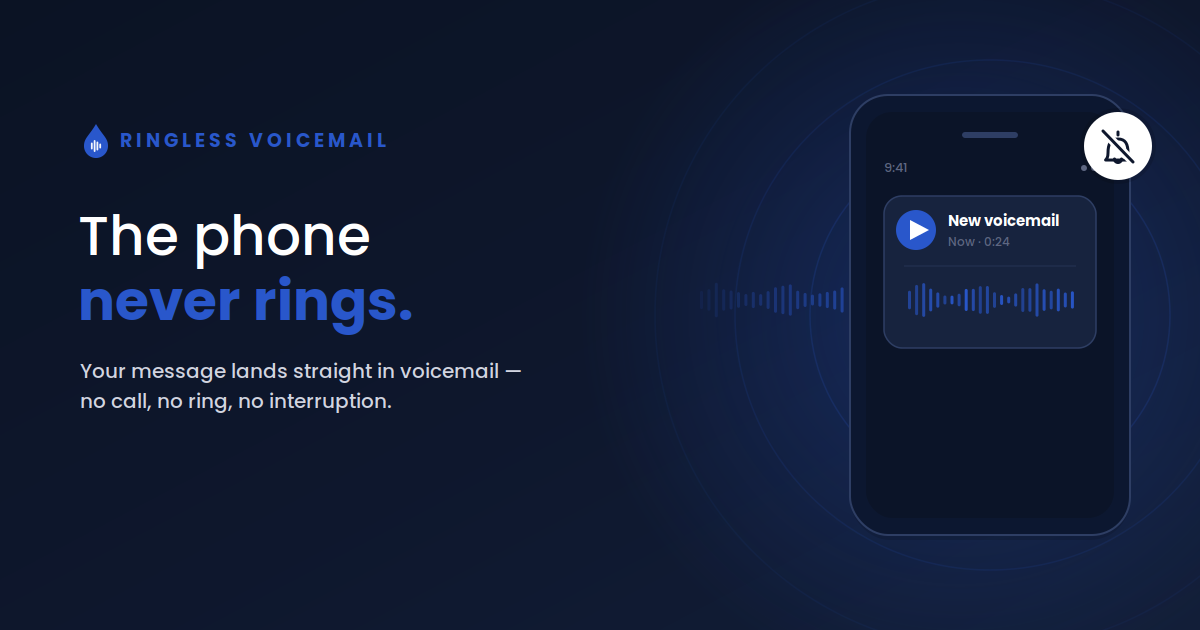
Most people have received a ringless voicemail without ever realizing it. Your phone never rang, but a new voicemail notification appeared — and the message inside was clearly recorded in advance. That’s ringless voicemail, and for businesses doing outbound outreach it has quietly become one of the most reliable ways to reach people who no longer answer unknown numbers.
Here’s what it is, how the technology actually works, and why response rates hold up when other channels don’t.
What ringless voicemail is
Ringless voicemail, sometimes called RVM or a voicemail drop, is a pre-recorded audio message delivered directly into someone’s voicemail inbox without placing a traditional call. The recipient’s phone doesn’t ring. There’s no missed call in their log. They simply see a voicemail waiting and listen to it whenever they choose.
For the business sending it, one recording can reach thousands of contacts in the time it would take an agent to dial a couple dozen numbers manually.
How the technology works
A normal phone call connects to the recipient’s handset, and only after they ignore it does the carrier route the call to voicemail. Ringless voicemail skips that step entirely.
Instead of dialing the handset, the system establishes a connection with the voicemail server on the carrier’s network — the same server that would eventually store a missed-call message — and deposits the audio file there directly. Because the handset is never part of the transaction, the phone has no reason to ring.
The recipient’s device then does what it always does when a new message arrives: it displays a voicemail notification. From the recipient’s perspective, nothing unusual happened.
Why businesses use it
The appeal comes down to a change in how people treat their phones. Unknown numbers get screened by default. Cold calls get declined before the second ring. Emails pile up unread, and text messages get scrolled past.
Voicemail is different for one specific reason: it waits. The recipient listens when they have a free moment, which means the message gets a fair hearing rather than competing with whatever they were doing when the phone buzzed. That patience is the entire advantage.
There’s a second benefit that’s easy to overlook. When someone listens to a voicemail and calls back, they’re initiating the conversation. The dynamic is completely different from a cold call — no defensive opening, no “how did you get this number,” no rushing to a pitch before they hang up. They already know why you called.
Where it fits in an outbound process
Ringless voicemail works best as a first-touch tool rather than a replacement for every call. A typical structure looks like this:
The drop goes out to a whole list. A portion of recipients listen and call back. Those inbound calls go to agents, who now spend their time on interested prospects instead of dialing numbers that never connect. Contacts who didn’t respond can get a text follow-up or a second drop later in the sequence.
The economics shift because agent hours move from dialing to talking.
What you need to know before sending
Ringless voicemail is a legitimate channel, but it isn’t a loophole. In the United States, outbound messaging is governed by the Telephone Consumer Protection Act and Federal Trade Commission rules, and the central requirement is consent — you need permission to contact the people on your list. Courts have not treated ringless voicemail as exempt from these obligations.
Practically, that means working from lists you have a lawful basis to contact, honoring opt-outs immediately, and keeping records of both. The platform can automate the mechanics; the responsibility for the list is yours.
Is it worth it?
For any business whose revenue depends on reaching people who don’t pick up — real estate, lending, home services, automotive, high-volume call centers — the arithmetic usually answers the question. One drop reaches every contact on the list. A day of manual dialing reaches whoever happened to be free.
If you want to see how it works in practice, you can send your first campaign in a few minutes.