It’s the first question almost everyone asks, and the honest answer has two parts: yes, ringless voicemail is legal — and no, that doesn’t mean you can send it to anyone you like.
The distinction matters enormously, because the businesses that get into trouble aren’t the ones using the technology. They’re the ones using it on lists they had no permission to contact.
This article is general information, not legal advice. Regulations change and vary by jurisdiction. Have your own counsel review your outbound program before launching.
The short version
There is no law that bans ringless voicemail as a technology. What the law regulates is who you contact, whether they agreed to hear from you, and what you do when they ask you to stop. Those rules apply whether you reach someone by live call, automated call, text message, or voicemail drop.
Early on, some providers argued that because the phone never rings, ringless voicemail falls outside the Telephone Consumer Protection Act. That argument has not held up well. Regulators and courts have generally treated the delivery of a pre-recorded message to a consumer’s phone as the kind of contact the TCPA was written to cover. Building a compliance strategy around the hope that it’s exempt is a bad plan.
What the TCPA actually requires
The Telephone Consumer Protection Act governs how businesses can contact consumers by phone. The pieces most relevant to voicemail campaigns:
Consent. You generally need permission before sending marketing messages to a consumer’s mobile number. For purely informational or transactional messages, the standard is often lower than for marketing, but marketing typically requires prior express written consent.
Existing relationships. Contacting your own customers about something related to their account or purchase sits on much firmer ground than cold outreach to a purchased list. It isn’t unlimited, but the position is stronger.
Opt-outs. When someone asks not to be contacted again, that request has to be honored promptly and permanently across all your campaigns.
Do Not Call obligations. The national registry and various state registries restrict marketing contact to listed numbers. Scrubbing your lists is not optional.
Where businesses actually get in trouble
In practice the same handful of problems recur:
Purchased lists with no verifiable consent. A vendor telling you a list is “opt-in” is not the same as being able to prove it. If a claim arrives, the burden falls on you.
Ignoring or slow-walking opt-outs. This is both the easiest thing to get right and one of the most commonly litigated failures.
No records. If you can’t show when and how someone consented, you effectively can’t defend the contact.
Assuming the tech creates an exemption. It doesn’t.
What good compliance looks like
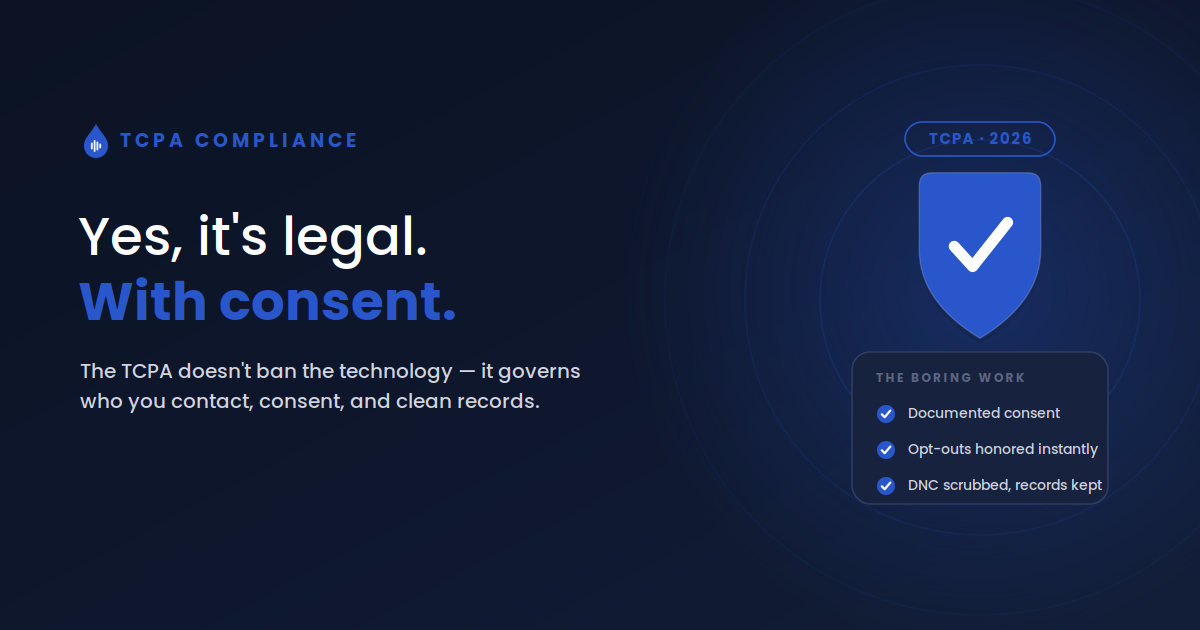
The mechanics aren’t complicated. You collect consent in a way you can document, you keep those records, you scrub against DNC registries, you process opt-outs automatically and immediately, and you keep delivery records showing exactly who was contacted and when.
A good platform automates most of this — opt-out handling, suppression lists that apply across every campaign, and complete delivery logs. What no platform can do is vouch for a list you uploaded. That part stays with you.
Outside the United States
Rules differ substantially by country. Canada’s CASL, the UK and EU’s GDPR and PECR, and Australia’s Spam Act each impose their own consent and record-keeping requirements, and several are stricter than the US framework. If you’re contacting people across borders, get local advice rather than assuming your domestic process transfers.
The bottom line
Ringless voicemail is a legal, legitimate channel used by regulated industries every day. It stays legal through the boring work: clean lists, documented consent, fast opt-outs, and good records. Do that, and it’s simply another outreach channel. Skip it, and the technology you used won’t be what got you in trouble.