There’s a common assumption that voicemail timing doesn’t matter much, because the message waits for the recipient anyway. That’s half right. The drop does wait — but when you send determines when the callbacks arrive, and that turns out to be the thing worth optimizing.
Reframe the question
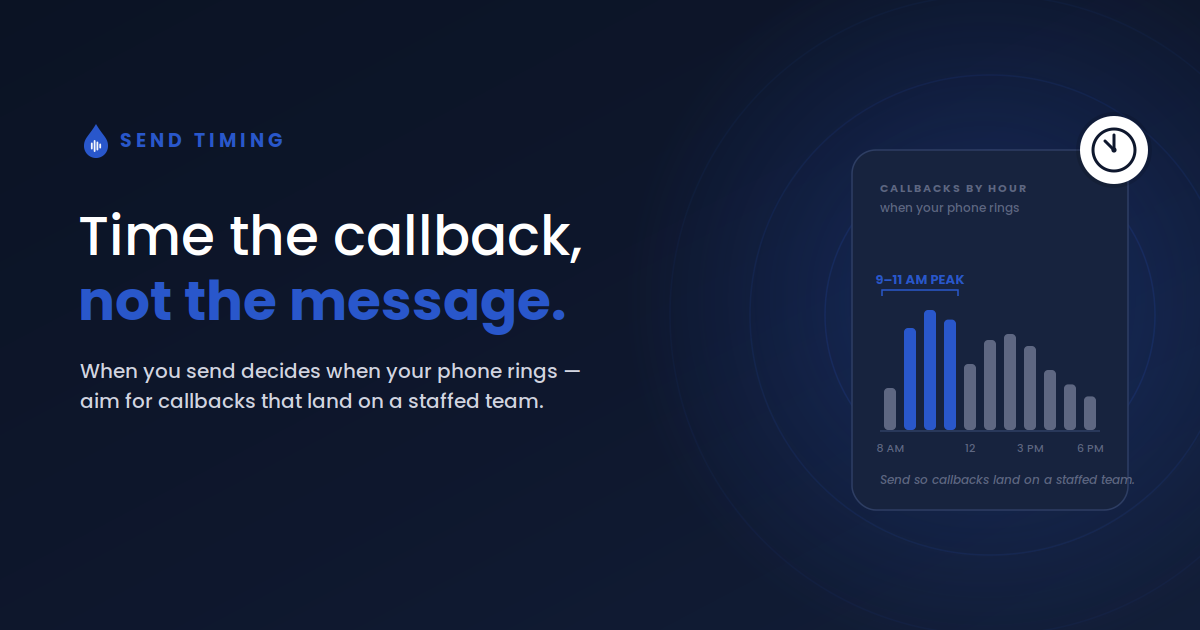
You’re not choosing when someone hears your message. You’re choosing when your phone rings.
That changes the calculation. The best send time is the one where the resulting callbacks land while your team is staffed, alert, and able to answer immediately. A campaign that generates fifty callbacks at 7pm on a Friday, when nobody’s there, has wasted most of them — the ones who call once and get voicemail often don’t try again.
General patterns worth knowing
Broad tendencies, all of which should be tested against your own data:
Mid-morning, roughly 9am to 11am. People are at their desks, working through their phone, and willing to return calls. Consistently one of the strongest windows.
Early afternoon, 1pm to 3pm. Post-lunch is reliable for consumer outreach in particular.
Late afternoon. Callbacks start slipping as people wind down and defer anything non-urgent to tomorrow.
Evenings. Generally weak for B2B, sometimes viable for consumer audiences who aren’t reachable during work hours — but consider whether it reads as intrusive.
Weekends. Highly audience-dependent. Home services and real estate sometimes do well Saturday morning; B2B rarely does.
Day of week
Midweek tends to outperform the edges. Monday mornings compete with everyone’s inbox backlog, and Friday afternoons compete with people mentally leaving for the weekend. Tuesday through Thursday is the reliable core.
That said, some industries invert this entirely. Storm-response roofing doesn’t care what day it is. Florists send on the specific days before a holiday. Let your business logic override the general pattern.
Time zones are not optional
If your list spans multiple zones, sending everything at once means a 9am campaign lands at 6am for some recipients. That’s a bad first impression and, depending on the hours involved, a compliance concern — calling-time restrictions exist and are enforced.
Segment by time zone and schedule each segment to its own local window. It’s a small amount of setup that prevents an avoidable problem.
Match sends to your staffing
This is the piece most teams miss. If a large blast produces a callback spike your floor can’t absorb, you’ve paid for contacts you couldn’t convert.
Two fixes:
Trickle delivery. Release drops gradually over hours so callbacks arrive at a rate matching your available agents.
IVR routing. When volume does spike, an interactive menu answers every caller, routes them, and captures a number if nobody’s free — so nothing hits a dead end.
Find your own answer
Take one list, split it into four segments, and send at four different times across a week. Track callback rate and — more importantly — callback-to-appointment rate, since a callback that nobody answered isn’t worth much.
A single week of testing gives you a send-time answer specific to your audience, which beats any general guidance including this article’s.