Short. Shorter than you think, and almost certainly shorter than your first draft.
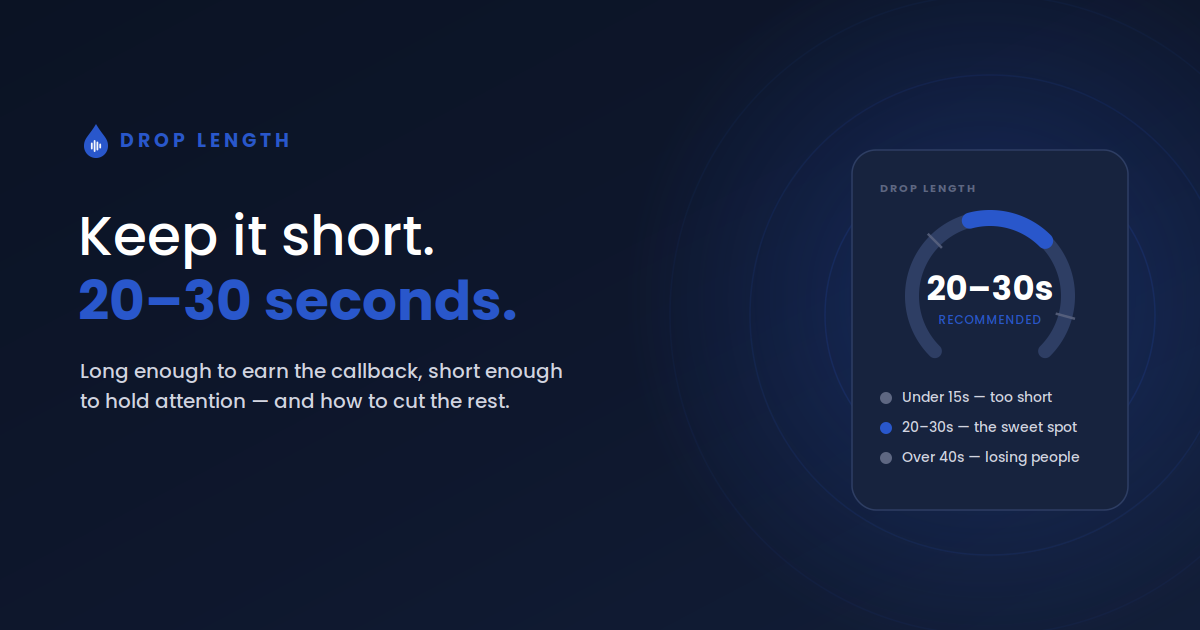
If you want a single number: aim for twenty to thirty seconds. Under twenty can feel abrupt for a cold contact. Past forty, you’re losing people mid-message, and everything after that point may as well not have been recorded.
Why length matters so much
A voicemail is a linear medium. The listener can’t skim it, can’t skip to the part that matters, and can’t tell how long it runs before committing to it. Every additional second asks for more patience without offering anything in return.
There’s a specific failure mode worth understanding: people don’t decide to stop listening at the end of a sentence. They stop when the message stops feeling relevant to them. If your reason for calling arrives at second twenty-five, a large share of listeners are already gone.
What fits in thirty seconds
More than you’d assume, if you’re disciplined. Spoken at a natural pace, thirty seconds is roughly seventy-five to eighty words — enough for:
- Your name and company
- Who you’re calling and why, specifically
- One concrete reason to call back
- Your number, spoken clearly
That’s a complete message. What doesn’t fit is company history, feature lists, three different offers, or a warm-up.
How to cut a script that’s too long
Record your draft and time it. If it runs over, work through it in this order:
Cut the opening pleasantries. “I hope you’re having a great day” costs three seconds and adds nothing.
Cut the second offer. If you’re mentioning two things, one of them is diluting the other.
Cut qualifiers. “I was just calling because I wanted to reach out and see if maybe you might be interested in” is fifteen words doing the work of three.
Cut the second call to action. One instruction, once.
Don’t cut the number. Say it slowly, and say it at the end where people expect it. Rushing the number is how you lose a callback you’d already earned.
Should you say the number twice?
It depends on your audience. For a cold list, repeating the number at the end can help — some listeners will replay the message anyway, but not all will bother. For warm contacts who already have your number, once is plenty and the repetition eats seconds you could use better.
If you do repeat it, make sure the total still lands under thirty-five seconds.
Does shorter always win?
Not quite. A message that’s too short can read as abrupt or vague, especially for a first touch. Eight seconds of “Hi, it’s Dave, call me back” from a stranger doesn’t give anyone a reason to act. The floor is roughly fifteen seconds for cold outreach — enough to establish who you are and why the call is worth returning.
The sweet spot is short enough to hold attention and long enough to earn the callback.
Test it on your own list
Length interacts with audience. A past customer will listen longer than a cold prospect. A B2B contact may tolerate more detail than a consumer. Record a twenty-second version and a thirty-five-second version of the same message, split your list, and compare callback rates.
Do that once and you’ll know your own number rather than a general rule.