Cold calling still works. That’s not in dispute. The question is whether it’s the most efficient way to spend an agent’s hour — and once you break the numbers down, the answer usually depends on how many of your dials actually connect.
Where the hour goes
Consider a single agent making manual outbound calls for one hour. Realistically that’s somewhere in the range of forty to sixty dials, depending on the dialer and the list.
Of those, most won’t connect at all. Some numbers are wrong or disconnected. Some go to voicemail. Many are simply screened, because answering unknown numbers is no longer normal behavior. The agent might have a handful of actual conversations, and a portion of those end in the first fifteen seconds.
So the hour produced a small number of real conversations, and the agent’s salary paid for all sixty dials.
The same hour with drops
Now run the same list through a voicemail drop campaign. One recording reaches every contact on it. The agent isn’t dialing at all — they’re waiting for callbacks, and the callbacks come from people who listened to the whole message and chose to respond.
The critical difference isn’t just volume. It’s who’s on the other end. A callback is a self-selected prospect. They know who you are, they know why you called, and they picked up the phone on purpose. Conversion on those conversations runs meaningfully higher than on interruptions.
Running the math
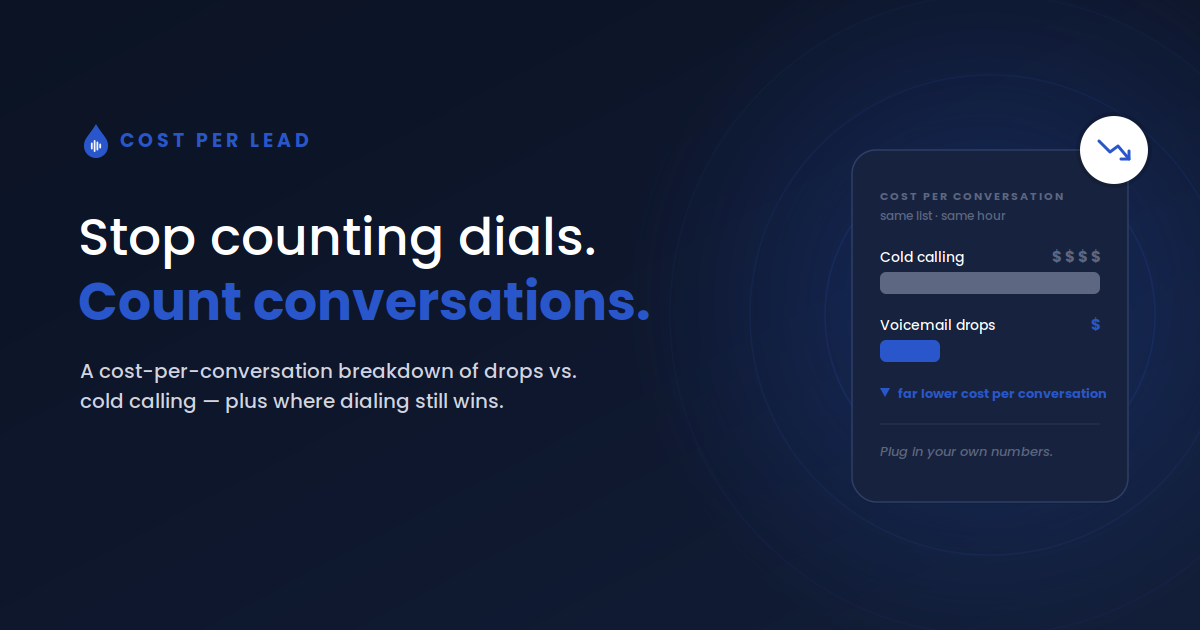
The comparison that matters isn’t cost per dial or cost per drop — it’s cost per conversation, and then cost per closed deal.
For cold calling, your cost per conversation is essentially the agent’s hourly cost divided by the number of real conversations that hour produced. Because connect rates are low, that number tends to be higher than teams expect.
For drops, the cost has two parts: the per-drop cost, which at volume is a fraction of a cent, plus the agent time spent handling callbacks. Because the agent spends nearly all of their time in conversations rather than dialing, the cost per conversation falls sharply.
Plug in your own numbers — your agent cost, your historical connect rate, your callback rate — and the gap is usually wide enough that it isn’t a close call.
Where cold calling still wins
To be fair about it, there are situations where dialing is the better choice.
Very small, very high-value lists. If you have thirty enterprise accounts, call them. Personally. Repeatedly.
Relationships already in progress. You don’t drop a voicemail on a deal in negotiation.
When you need an answer today. A drop waits for the recipient. A call doesn’t.
Complex qualification up front. If the first conversation has to be exploratory, live dialing is the tool.
The realistic answer: run both
Most teams that adopt drops don’t abandon calling. They reorder it. Drops handle first contact across the entire list. Callbacks and identified interest go to live agents. Cold dialing gets reserved for the accounts that justify individual attention.
The result is that agent hours move from finding people to talking to people — and that’s the shift that changes the cost structure of the whole operation.
What to measure
Before you decide, get honest baseline numbers: your connect rate on manual dialing, conversations per agent hour, cost per conversation, and cost per closed deal. Then run a drop campaign on a comparable segment and measure the same four things.
You’ll have a real answer for your business in a couple of weeks, which is better than anyone’s benchmark.